



How Long Before You Can Walk on New Turf? A Comprehensive Guide to Lawn Establishment
How Long Before You Can Walk on New Turf Achieving a pristine, lush green lawn is a rewarding project, but the excitement of installing new turf often leads homeowners to make one critical mistake: using the lawn too soon. Many people ask, “How long before you can walk on new turf?” The short answer is 2 to 3 weeks, but the real process involves much more than just waiting for the calendar to turn.
To ensure your investment lasts for years without patchiness or uneven growth, you must understand the biological “knitting” process happening beneath the soil surface. This guide covers everything you need to know about protecting your new lawn during its most vulnerable stage.
The Biological Reality: What Happens Under the Turf?
When you buy turf, it is essentially a “living carpet” that has been harvested. Once laid, the grass must transition from its original growing environment to your garden’s soil. This is a high-stress period for the plant.
The roots are not initially attached to your soil. They are suspended in the thin layer of soil that comes with the turf roll. For the first 14 days, the grass is entirely dependent on surface moisture. If you walk on it, the weight compresses the soil, restricts oxygen flow to the roots, and can snap the tiny, newly emerging root hairs. This is why “patience” is not just advice—it is a technical requirement for lawn health.
The 2–3 Week Timeline: A Detailed Breakdown
Phase 1: The Root-Knitting Phase (Days 1–7)
During the first week, your turf is in “shock.” The grass blades may look green, but they are fragile.
- Status: Do not step on the lawn.
- Critical Task: Keep the turf moist at all times. If the edges begin to dry out or turn brown, it is a sign that the roots are failing to make contact with the soil.
Phase 2: The Anchor Phase (Days 8–14)
By the second week, the roots begin to extend into the sub-soil. This is when the “tug test” becomes useful.
- Status: Still avoid traffic.
- The Pro-Tip: Gently tug at a corner of a turf roll. If you feel resistance, the roots are starting to anchor. If the roll moves easily, you must continue to stay off the area.
Phase 3: The Stabilization Phase (Days 15–21+)
This is when you can begin light, cautious activity.
- Status: You may walk on the lawn for necessary maintenance, but avoid heavy activity, pets, or outdoor furniture placement.
Advanced Maintenance: Tips for Faster Establishment
If you want to ensure your lawn recovers quickly and becomes durable, follow these professional maintenance strategies:
1. The “Board Walk” Technique
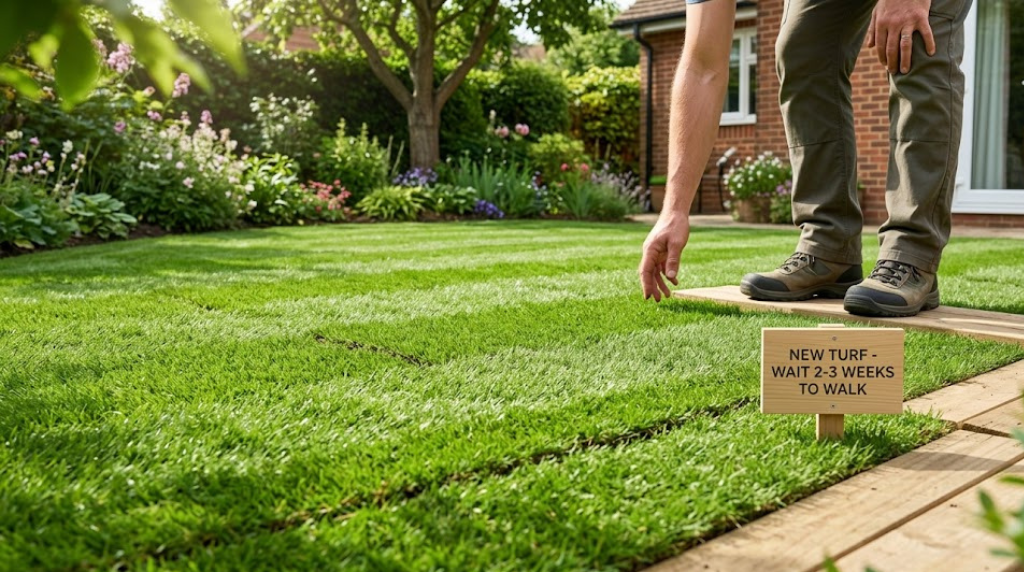
If you must cross your lawn to access other parts of your garden, never walk directly on the turf. Lay down wide plywood or scaffolding boards. These boards distribute your body weight across a large area, preventing the grass from sinking into the soft, unestablished soil.
2. Managing Pets and Wildlife
Pets are the #1 cause of failed turf installations. Their claws act like little aerators that pull up the edges of the turf, and their running patterns create uneven tracks. Even if the grass looks “okay” after 10 days, one game of fetch with a dog can ruin the root bonding process permanently. Keep pets off the lawn for a full 4 weeks.
3. Proper Watering (The “Morning Routine”)
Watering too late in the evening can encourage fungal growth, while watering too little leads to “turf shrinkage.” Aim to water early in the morning. If you see pools of water, you are over-watering. The soil should be damp, not muddy. Walking on muddy soil is equivalent to walking on wet concrete—it will leave permanent indentations.
Why Your Lawn Might Not Be Ranking (Common Mistakes)
If you have tried other articles and they aren’t working, it is likely because they miss these specific technical details:
- Ignoring Soil Prep: Turf on compacted soil takes twice as long to establish.
- No Mention of Mowing Height: Mowing too short too early is a common reason for lawn failure.
- Lack of Seasonal Context: Turf laid in July needs twice the water of turf laid in September.
For further guidance on maintaining a healthy lawn throughout the seasons and learning more about soil health, you can refer to the official expert guidelines provided by the Royal Horticultural Society (RHS).
Frequently Asked Questions (FAQs)
Q1: Can I walk on new turf after one week if I walk very lightly? No. Even light weight can cause the turf to shift slightly. This “micro-shifting” breaks the fragile new root hairs, effectively resetting your clock. It is safer to wait the full 2–3 weeks.
Q2: How do I know if my turf has established properly? Perform the “Tug Test.” If you cannot pull the edge of the turf up without pulling the soil with it, your turf is firmly anchored. Also, if the seams between the rolls have disappeared and the grass looks like a solid sheet, you are ready for normal use.
Q3: What if I have to move furniture onto the lawn? Wait at least 4 to 6 weeks before placing heavy items like trampolines, patio furniture, or paddling pools. These items block sunlight and restrict air, which can cause the grass underneath to yellow or die, leading to bald patches.
Q4: Does the time of year change how long I wait? Yes. In spring or early autumn, the grass is in an active growth phase and will knit faster. In winter, growth slows down significantly. If you install turf in winter, you may need to wait 4–5 weeks before allowing any traffic.
Q5: Can I fertilize the lawn immediately? It is generally better to use a “pre-turf fertilizer” under the soil before installation. If you didn’t do this, wait until the lawn has been mowed at least twice (usually around 4–6 weeks) before applying any high-nitrogen lawn feed.
Conclusion: The Path to a Durable Lawn
The question of how long before you can walk on new turf is simple, but the process requires discipline. By giving your lawn 3 weeks of “rest,” you are allowing the root system to build the foundation required for years of enjoyment.
Protecting the surface, watering correctly, and being patient during the first month are the hallmarks of a professional landscaper. Follow these steps, and you will not only have a green lawn today—you will have a robust, high-performance garden that can handle the activities of your family for years to come.
Want to learn more about your garden’s wildlife? Read: Is it lucky to have a hedgehog in your garden?